
Why the District Cooling System Is Growing in Singapore’s Commercial Districts
Singapore’s commercial districts run on air conditioning. In a city where temperatures hover between 25°C and 34°C year-round, cooling office towers, retail malls, and mixed-use developments is a baseline operational requirement. The district cooling system addresses this at scale: a single centralised cooling system distributes chilled water across an entire district through underground insulated pipes, replacing dozens of isolated building-level chiller units.
The approach is gaining traction because it resolves three pressures simultaneously: soaring energy consumption, shrinking urban land availability, and escalating sustainability commitments. This article examines why district cooling is expanding and why building owners and developers are increasingly choosing it over conventional air conditioning infrastructure.
High Cooling Demand Drives the Case for District Cooling Systems
Commercial buildings in Singapore’s central business districts operate air conditioning systems continuously. Office towers, retail hubs, and mixed-use developments around Marina Bay, Orchard Road, and Jurong Innovation District collectively consume enormous quantities of electricity on cooling alone.
A district cooling system meets this demand through economies of scale. Centralised chilled water production is significantly more efficient than each building running its own independent cooling system. Load balancing across multiple buildings allows plant operators to run equipment at higher load factors, reducing electricity consumption per unit of cooling delivered.
Space Savings: Eliminating the Cooling Tower from Singapore’s Rooftops
Land is Singapore’s most constrained resource. Every square metre committed to mechanical plant is a square metre unavailable for lettable floor area or revenue-generating use.
Conventional air conditioning systems require substantial rooftop and basement plant rooms to house cooling towers, chillers, and associated equipment. A district cooling system eliminates these requirements: buildings connected to the cooling network receive chilled water directly, with no rooftop chillers or cooling towers required.
At Punggol Digital District, the ENGIE-operated plant freed rooftop areas across the precinct for solar panels and green landscaped spaces. For commercial developers, this translates into reduced capital expenditure on mechanical, electrical, and plumbing fit-outs and improved net lettable area ratios.
Energy-Efficient Cooling Systems – Cost Savings at Scale
Operating a single large-scale district cooling plant with modern variable-speed drives, heat exchangers, and thermal energy storage systems is materially more efficient than running many small, independently maintained chiller systems in parallel.
At Punggol Digital District, ENGIE’s district cooling system achieves up to a 30% reduction in energy consumption compared to standard commercial buildings. Thermal energy storage allows the plant to shift chilled water production to off-peak electricity tariff periods, reducing operating costs further for buildings on the cooling network.
Maintenance costs follow the same logic. Building owners are relieved of capital expenditure cycles for chiller replacements and cooling tower refurbishment, with responsibility transferring to the district cooling operator.
Sustainability and Carbon Footprint Reduction Goals
Singapore’s Green Plan 2030 targets 80% of buildings achieving Green Mark certification, a 36% reduction in energy intensity by 2030, and net zero emissions by 2050. The district cooling system is a core infrastructure lever for reaching these goals in commercial districts.
The ENGIE plant at Punggol Digital District reduces carbon emissions by approximately 3,700 tonnes annually, equivalent to removing around 800 cars from Singapore’s roads. The Building and Construction Authority (BCA) recognises district cooling connections as a contributor to Green Mark scoring, and the Energy Market Authority (EMA) has supported district cooling as part of Singapore’s energy efficiency agenda.
For developers targeting institutional investors and multinational tenants, district cooling directly strengthens ESG performance metrics, green building ratings, and carbon footprint reporting.
Successful Implementation in Key Singapore Districts
Singapore has a proven track record with district cooling infrastructure at scale.
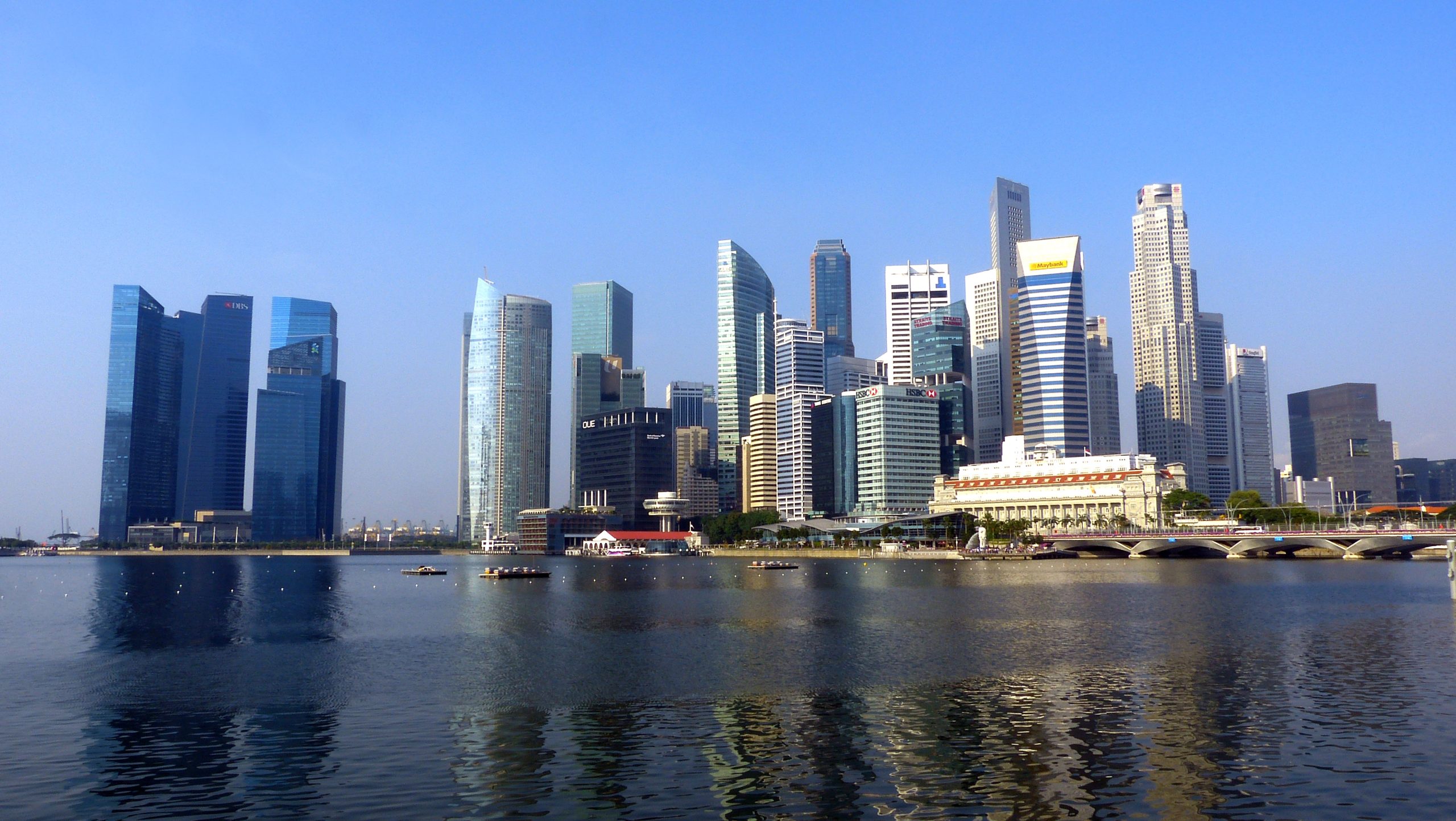
Marina Bay Financial District: SP Group operates a district cooling network supplying chilled water to Marina Bay Sands, Marina Bay Financial Centre, and surrounding commercial towers.
Punggol Digital District: ENGIE’s plant serves the mixed-use development with a cooling capacity of nearly 30,000 refrigeration tonnes. Pipes installed at 45-degree angles reduce pumping energy requirements; mechanical coupling cut construction time by nearly 80%.
Ang Mo Kio Technopark and Woodlands Wafer Fab Park: Singapore’s largest industrial district cooling system serves the semiconductor sector, including STMicroelectronics, demonstrating that district cooling extends beyond commercial office precincts.
Expansion into Jurong Innovation District and Changi Business Park signals district cooling becoming standard infrastructure for Singapore’s next generation of commercial and industrial clusters.
Benefits for Property Developers and Tenants
For property developers, district cooling reduces lifecycle mechanical and electrical costs, improves net lettable area, and accelerates Green Mark certification. Scalable cooling capacity is available from day one, removing the risk of under-specifying building-level plant.
For commercial tenants, a reliable chilled water supply from a professionally operated district cooling plant removes dependency on a single building’s ageing chiller. For both parties, enhanced ESG performance is a growing differentiator as institutional investors and corporate tenants assess sustainability credentials in every lease and acquisition decision.
Challenges and Future Outlook
District cooling requires substantial upfront investment in plant and underground distribution networks, making it most viable in high-density commercial precincts where cooling load density justifies the infrastructure cost. Connections must be designed into buildings during construction rather than retrofitted. Looking ahead, smart monitoring, AI-driven load forecasting, and expanded thermal energy storage will improve efficiency and resilience. Singapore’s pipeline of new commercial clusters presents natural opportunities to embed district cooling infrastructure from the ground up.
District Cooling Is No Longer a Choice; It’s the Infrastructure Singapore Is Building On
The district cooling system is growing in Singapore’s commercial districts because it solves real problems: excessive energy consumption, constrained urban land, rising sustainability requirements, and the mounting cost of building-level mechanical plants. It is proven technology, operating at Marina Bay, Punggol Digital District, and Singapore’s industrial parks, and it is scaling to meet the next generation of commercial development.
Partner with Lih Ming to develop efficient, scalable district cooling solutions for Singapore’s commercial and mixed-use developments. With over two decades of underground utilities expertise and an unparalleled track record, Lih Ming brings the technical precision that district cooling infrastructure demands. Contact us today.